Why Mark Carney’s Iran Position Is Triggering Political Controversy
Who Is Mark Carney?
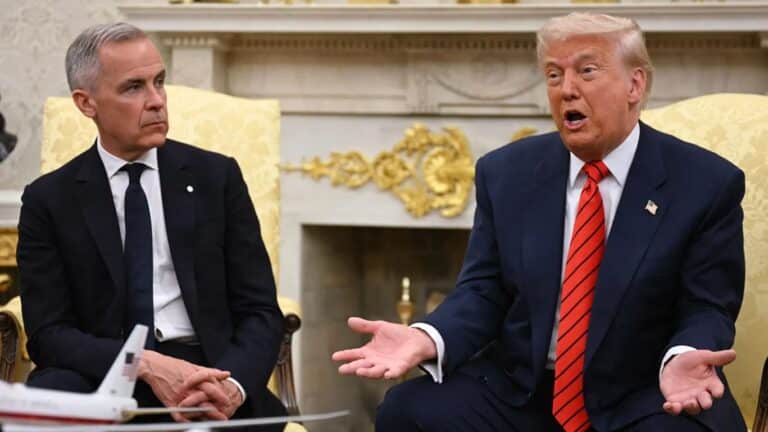
Mark Carney is the Prime Minister of Canada and leader of the Liberal Party. Before entering politics, he built an international reputation as a respected economist and central banker. Carney previously served as governor of the Bank of Canada and later led the Bank of England.
Known for his calm and technocratic style, Carney’s leadership has often been associated with steady decision-making during financial crises. However, the ongoing conflict between the United States, Israel, and Iran has created one of the first major foreign-policy challenges of his time in office.
Within just a few days in early March 2026, Carney issued several statements about the military campaign against Iran. The shifting tone of those statements has triggered criticism from analysts and politicians who say his messaging appears inconsistent.
Why Analysts Say Carney Appears “All Over the Place”
One of the most widely quoted critiques came from Nader Hashemi, a professor of Middle East politics at Georgetown University.
Speaking to Fox News Digital on March 5, 2026, Hashemi said Carney has been “all over the place” in his public messaging about the war with Iran. According to him, the prime minister’s statements seemed to shift between supporting the U.S.-Israeli strikes and raising concerns about international law and diplomatic consultation.
Hashemi argued that the changes may reflect domestic political pressure in Canada as well as the government’s effort to maintain its relationship with the United States.
What Mark Carney Said – And Why It Sparked Debate
February 28, 2026: Initial Support for the Strikes
On February 28, 2026, the same day former U.S. President Donald Trump announced the launch of Operation Epic Fury, Carney issued a statement that appeared supportive of the U.S.-Israeli military action.
Critics quickly noted that the statement did not mention the role of the United Nations or Canada’s traditional emphasis on international law.
March 2, 2026: A More Critical Tone
Just two days later, Carney adjusted his message. He stated that the United States and Israel had acted without consulting allies or engaging the United Nations.
While he did not withdraw support for preventing Iran from obtaining nuclear weapons, the statement sounded more cautious and diplomatic than his earlier comments.
March 4, 2026: Refusing to Rule Out Military Support
During a visit to Australia on March 4, Carney was asked whether Canada could join the conflict militarily.
He replied that Canada could never “categorically rule out participation” and said the country would stand with allies when appropriate.
This third position sparked the strongest reaction from critics, who argued that the government’s messaging had become confusing.
Political Criticism From Both Sides
Carney’s statements have been criticized across the political spectrum in Canada.
On the conservative side, Michael Chong, the opposition shadow minister for foreign affairs, said it was contradictory to support military strikes while also calling for them to stop.
Melissa Lantsman, deputy leader of the Conservative Party, mocked the government’s shifting position in a widely shared social media post summarizing the stance as: “We support it, we’re upset about it, we think it’s bad, but we might join in.”
From the political left, Alexandre Boulerice of the New Democratic Party condemned the U.S. and Israeli strikes and criticized Carney for initially backing the operation.
Could Canada Join the Conflict?
Some military analysts say direct Canadian involvement remains unlikely.
Retired Canadian major-general David Fraser told CTV News that Canada would probably only become involved if a NATO ally invoked Article 5 of the alliance treaty.
Canada is a member of NATO, meaning it could theoretically be drawn into the conflict if a member state requested collective defense.
What Canadian Public Opinion Shows
Public opinion in Canada appears divided but leaning against the military campaign.
A survey by the Angus Reid Institute found that 49% of Canadians oppose the U.S.-Israeli strikes against Iran, while 34% support them.
The results suggest that Carney faces domestic pressure to distance Canada from the conflict even as the country maintains strong strategic ties with the United States.
Why the Canada–U.S. Relationship Matters
The controversy comes at a time when relations between Canada and the United States are already complicated.
Tensions increased after trade disputes and tariffs imposed during the presidency of Donald Trump. The Iran conflict has added another layer of difficulty for Ottawa.
Canada is one of Washington’s closest allies through NATO and the Five Eyes intelligence partnership. At the same time, supporting a military campaign launched without a United Nations mandate is politically sensitive inside Canada.
Foreign Affairs Minister Anita Anand emphasized this balance at a defense conference in Ottawa, saying all sides should respect international law and calling for de-escalation.
The Political Challenge Facing Mark Carney
The debate over Iran highlights the tightrope Carney must walk as prime minister.
Supporting allies like the United States is strategically important for Canada, but public opinion and the country’s diplomatic traditions emphasize multilateral cooperation and international law.
As the conflict continues, Carney’s ability to maintain a consistent and credible position could play a major role in shaping both Canada’s foreign policy and his political standing at home.
About the Author